Iran's Nuclear and Syria's Iraq Adventures
by Barry Rubin
The two main areas where the alliance of radical forces in the Middle East confront Western interests and pose a danger of major instability are Iran's drive for nuclear weapons and Syria's efforts to destabilize Iraq. This article considers these two issues. First, it examines what effect Iran's obtaining nuclear weapons would have on Middle East politics, with an emphasis on scenarios that would occur even if Iran never actually uses them. Second, it asks why it is that the interests of Iran's ally, Syria, compel it to destabilize Iraq.
A Nuclear Iran and Middle East Politics
If Iran gets nuclear weapons and the missiles to deliver them to targets, what impact would it have on the Arab world? While this is necessarily speculative, an analysis of the strategic effect of Tehran having nuclear weapons is the most important piece of contingency planning in the world today. One can make some very educated guesses as to what would happen.
Public statements by Arab leaders, journalists, and others of indifference or even Muslim solidarity with Iran are more than matched by private remarks showing fear and hope that Tehran will be stopped. As so often happens, however, the Arab regimes and intellectuals will do almost nothing to help achieve the outcome they want. It is left in the hands of the West, the United States, or even Israel to block Iran's progress.
However, an outcome with Iran having nuclear weapons is more likely than the alternative.
A great deal of attention has rightly been paid to the possibility that Tehran might use nuclear weapons against Israel--especially given the threatening statements of Iranian leaders, which do not stop short of advocating genocide. If Iran had nuclear bombs it might well use them to attack Israel, a situation that would produce hundreds of thousands of deaths--especially if a nuclear exchange followed--and provoke the biggest crisis in the region's history. This is a terrifying possibility no matter how low one assesses its chances of happening. This threat is sufficient in itself as a reason to stop Iran from obtaining such terrible weapons, all the more since it is an extremist, aggressive government that has voiced its readiness to use them and has shown its willingness to employ terrorism.
While this is important, however, there are other elements of the issue that deserve fuller consideration. There are other outcomes that--compared to the actual firing of nuclear-tipped missiles or giving such arms to terrorist groups--are a 100 percent certainty given a nuclear-armed Iran. These strategic concerns are of the highest importance for the entire world.
This point would be true even if there were no oil and natural gas in the Persian Gulf area, but given the great concentration of these vital resources (and the systems for transporting them elsewhere) there, it becomes arguably the globe's most compelling issue.
Thus, given the premise that Iran were to obtain nuclear weapons and the missiles capable of delivering them, even in small numbers, how would politics and policies in the Arabic-speaking world be changed?
The Search for a Defensive Shield
Clearly, one step that Arab states would take--especially Saudi Arabia and the other members of the Gulf Cooperation Council (GCC)--would be to seek a nuclear umbrella from the West, especially from the United States. These governments would ask Washington for assurances of defense against any Iranian threat or attack, especially a stated willingness by the United States to strike at Iran with nuclear weapons in the event of their being used against any of Iran's neighbors.
It should be noted that the European Union would not play a central role here, being unwilling and unable to provide such a guarantee. Nevertheless, the position taken by the EU would be important, for any sign of doubt or opposition to such an umbrella would be interpreted both by Tehran and its neighbors as implying that no one can provide the ultimate defense against Iran.
There would also likely be other conventional military components to such a defensive umbrella. The North Atlantic Treaty Organization (NATO) could be involved; the GCC might seek to buy anti-missile defenses or warplanes capable of striking at Iran from Western states. Western forces might be placed in the Gulf as tripwires to deter Iran from attacking, since then a nuclear strike against, say, Saudi Arabia, would be an attack on the whole Western world.
Yet there is a major problem with the idea of direct military aid or involvement that would give Arab states, especially those in the Gulf, a greater sense of security vis-à-vis Iran. For one of Tehran's demands--supported by domestic opinion in Arab states as well as Iran's own threat--would surely be not to engage in such activities (see below). Furthermore, most or all Arab states would probably comply at least up to a point with this attempt to deny them a strong defensive alliance.
Nukes of Their Own
Another potential response of at least some Arab states would be to seek their own nuclear weapons and delivery systems. It is easy to underestimate what a big undertaking this would be. After all, it is not just a matter of purchasing some nuclear technology. Either the country has to be capable of building both workable weapons and missiles capable of carrying them or of purchasing them readymade.
Yet only the Saudis among Gulf Arab states are likely to be willing and able to undertake such an effort. It is most unlikely that Egypt, Jordan, Lebanon, Qatar, Kuwait, Iraq, Oman, Bahrain, the United Arab Emirates, or others would either seek or have much prospect of obtaining nuclear weapons or sophisticated, comprehensive anti-missile defenses.
Moreover, even if Arab countries do obtain such weapons, they must be maintained properly, amply protected, and carefully managed in deciding under what conditions they might be used, who would control them, and many other difficult questions. The dangers are enormous, including the possibility of provoking a stronger Iran, thus weakening rather than strengthening deterrence. It is likely that all Arab countries, even Saudi Arabia, would reach the conclusion that seeking an independent nuclear capability is more trouble than benefit.
One factor here is that having nuclear weapons is a risky matter in several strategic respects. This is especially true for a country whose stability and technical skills are not assured, as well one where dissident elements or opposition terrorists might seek to seize such arms or facilities. Taking these points into account, aside from their own anti-proliferation stance, Western states, including the United States, are not going to help Arab countries get nuclear weapons or missiles capable of carrying them.
Consequently, simply saying that countries would respond to an Iranian nuclear capability by getting their own weapons is no answer to the new situation created by Tehran's having atomic weapons.
Appeasement
In connection with seeking an American umbrella, the most attractive strategy for Arab states is appeasement of Iran. The fact that most or all European countries would move in a parallel direction would only reinforce this trend.
The key question here is: What would Iran demand and Arab states be willing to give in order to achieve this goal? One possibility is a lack of cooperation with the United States in combating Iranian ambitions and threatening its nuclear arsenal, which might also include pressure not to grant basing rights to American forces--at least any new ones--as well as not taking part in any campaign to isolate or impose sanctions on Iran. Other demands might include no peace agreements with Israel, acceding to Iranian demands for high oil prices, non-interference with Iranian influence in Iraq, and minimizing verbal criticism of Iran, its system, interests, and allies.
Somewhat harder to swallow would be acceptance of Iran's leading role in Gulf security. Tehran's position has been that security arrangements should involve only the local states, thus minimizing outside defensive support for Gulf Arab states and further enhancing Iranian goals. This may also involve a more positive attitude toward Iran's allies. This could include friendlier policies toward Syria, not opposing Hizballah's efforts to gain veto power or hegemony over Lebanon's government, and accepting the primacy of Hamas over Fatah in the Palestinian arena.
These concessions taken together would further weaken Arab resistance to Iranian regional (or at least Gulf) hegemony and undermine Western (or at least American) efforts to construct an anti-Iranian alliance. If Arab states are too frightened to admit they fear Iran having nuclear arms before it has even obtained them--much less being willing to act to avoid this outcome--how will they react when Tehran actually does have such weapons of mass destruction?
HISH Power
The central issue in the Middle East today is the conflict between the radical HISH alliance (Hamas-Iran-Syria-Hizballah) and the Arab nationalist Sunni regimes. HISH projects its power through a variety of means, including radical Islamist ideology, sponsorship of terrorism, covert or overt backing for revolutionary clients, and the direct power of Iran and Syria.
What would happen to Arab politics in a situation in which Iran had nuclear weapons must be considered in this context.
At present, the main battlefronts are in Iraq and Lebanon, and for control of the Palestinian leadership. Moreover, in every Arabic-speaking country (except for in Syria itself, where they have been largely though perhaps temporarily coopted) radical Islamist forces are the main opposition to the existing governments.
Historically, of course, Iran faced serious problems in projecting its influence into the Arabic-speaking world. There were three barriers in particular, and all of them have eroded. First, Iran is a non-Arab state, directed by ethnic Persians. Though it also includes other ethnic elements, few of them are Arabs. Arab nationalism has thus been antagonistic toward Iran, a factor manipulated by its Arab rivals and accepted by their people. (A notable example was Iraq's use of anti-Persian propaganda during the 1980-1988 Iran-Iraq War.)
Through the HISH alliance, however, Iran has passed through this barricade by having three major Arab allies--Palestinian Hamas, Lebanese Hizballah, and Syria--as well as considerable assets among Iraq's Shi'a Arabs. In addition, the appeal of Iran's line using Islamism, anti-Westernism, total opposition to Israel's existence, and revolutionary passion has appealed to many Arabs.
On the Arab-Persian issue, many Arabs are still totally opposed to any power by Tehran over "their" region. The GCC countries view Iran as a direct threat. Egypt sees it as an unwanted rival for leadership. Fatah is suspicious of Iran's sponsorship for Hamas and plays the "anti-Persian" card, as does the governing coalition in Lebanon. Still, many Arabs are no longer persuaded that they must oppose Iran as a non-Arab force.
Second, Iran is a predominantly Shi'a Muslim country, and the "Islamic" regime is very much a Shi'a and not a Sunni one. The majority of the Arabic-speaking world is Sunni and has certainly been ruled by Sunnis even when they are in the minority (Iraq, Bahrain, and in a sense Lebanon).
Through the HISH alliance, though, Iran has also passed this barricade. Hamas is Sunni, and Syria has a Sunni Muslim majority that supports the regime even if it does not comprise it. Using the methods discussed above, Iran can claim more appeal than ever before on the basis of Islamism, even with Sunni forces. However, many Sunnis--including Islamists like the Muslim Brotherhood--and especially the Saudis are still mobilized by hatred and fear of the Shi'a.
Third, leadership in the Arabic-speaking world was dominated by the battle among the strongest Arab states (Egypt, Iraq, and Syria), leaving no room for an outside contender. Today, however, there is a leadership vacuum in the Arab world. Iraq will be in too much disorder to be concerned with regional issues for some years to come. The leadership bid by its ruler, Saddam Hussein, not only failed but contributed greatly to the regime's downfall. A weaker Syria has hitched itself to Iranian leadership while Egypt has turned very much inward, unable to project any influence outside its own borders. Even Jordan's King Hussein, who ruled a small country but cast a giant shadow, is no more. The door is open to Iran's bid for hegemony.
Iran's success is by no means complete. Still, it is hovering on the verge of serious success. Its clients are close to power in Iraq, Lebanon, and among the Palestinians. Its popularity among Arabs and Sunnis is at an all-time high. One can understand if leaders in Tehran believe that the future belongs to them, even though this might be a major miscalculation. Indeed, making such a misestimate of the balance of force might produce a giant crisis, especially if Iran has nuclear weapons.
Springtime for Tehran
In this context, then, it is possible to analyze the tremendous boost that possessing nuclear weapons would give to Iran, its allies, and its ideology.
Islamism
Buoyed by having a "superpower-type" sponsor and the "proof" of how effective an Islamist government is, radical Islamist forces around the region would grow rapidly in numbers and boldness. They would argue that Iran can stand up to America, subvert the existing Arab regimes, and destroy Israel.
The rush to Islamism would parallel the growth of radical Arab nationalism after such "successes" as Egyptian President Gamal Abdel Nasser's nationalization of the Suez Canal Company and survival of an international assault in the 1950s. A tidal wave of recruitment to radical Islamist movements throughout the Arab world would take place, and these groups would be more aggressive in fighting regimes (notably in Jordan, Lebanon, and Egypt), including the use of violence. The appeal of Arab nationalism could collapse, at least in specific countries, and several more Islamist regimes might very well take power.
Syria
Under the protection of Iran's nuclear umbrella, Damascus would be more aggressive toward Israel, in subverting the Lebanese government, and in promoting insurgency in Iraq. Such adventurism could lead to direct war with Israel, even if that is not the Syrian regime's conscious intention.
Lebanon
Hizballah and Syria's politician clients might succeed in either forming their own government there or at least in getting veto power over the regime's decisionmaking process. With control over the country ensured, Hizballah would be more likely to launch a campaign that would lead to another war with Israel.
Iraq
Iran's influence among Iraqi Shi'as would skyrocket. Tehran could and probably would use this to force out any U.S. presence and move Iraq in the direction of being a satellite state (even if it did not succeed completely). Even an independent-minded Iraqi government would feel that a strong, neighboring Iran was a more important factor to please than a distant and fickle United States.
Arab-Israeli Conflict
The chance of resolving the Arab-Israeli conflict diplomatically would be zero, as the growing numbers of radicals would believe they could win completely, and the relatively moderate would be too scared to take any action that might be defined as treasonous. With Hamas winning even more over Fatah--and Fatah pushed toward a harder line, perhaps even a deal with Iran--no Palestinian leader would negotiate seriously. This is already true, and it would be even more so.
Saudi Arabia and the Gulf
The Saudis and other Gulf countries would be very intimidated by Iran's growing power. They would try to survive by propitiating Iran and by ensuring Western support, but their priority would swing toward the former factor. Internal revolutionary and terrorist movements would probably increase and be disruptive, even if they did not come into power. Oil and natural gas prices would skyrocket in view of the market's fear of regional instability.
Conclusions
All in all, the outcome would be incredibly damaging for Western interests. The kind of postwar interventionism that took place in Kuwait in 1991 and Iraq in 2003 would be impossible, since now Iran--in place of the USSR--would hold the balance. The type of hopeful diplomacy contained in the 1990s peace process would be impossible since the Arab side would be held in thrall to Iranian and radical Islamist pressures.
Western attempts to conciliate Iran would be tougher since Tehran could maintain that it achieved nuclear weapons despite opposition from the West. Since it is so powerful, why should it make any concessions at all to a side it sees as frightened and in historic decline? That idea--that Iran is on the winning side of history--would have enormous appeal in the Arabic-speaking world.
This is a very gloomy assessment, but it is hard to see how a different one is more likely. To reiterate, even assuming that Iran never uses nuclear weapons, the possession of them alone is likely to create an enormous, earthquake-like strategic shift in the region and in Arab politics.
SYRIA AND IRAQ: THE STRUGGLE FOR ARAB HEGEMONY
Syria has been a major exporter of instability to Iraq, and thus the Damascus regime. It is a major promoter of disorder there and clearly does not fear the radical Islamists it is helping as either a force in Iraq or as a threat to Syria itself. Some Western observers have argued that Syrian interests are parallel to those of their own countries. If this is true at all it is due only to the fact that parallel lines never meet.
American and Iraqi officials have consistently made this point in no uncertain words, and in increasingly specific terms. In November 2005, then Prime Minister Ibrahim Jafari explained, "We demand that [Syria] control [its] borders, prevent infiltration and terrorism. We want good relations with Syria, but this cannot be achieved when such violations exist."
In September 2006, Iraqi Deputy Prime Minister Barham Salah said that Iraq wanted to "get our Syrian neighbors to behave more responsibly... and to clamp down on the presence and activity of some of the former regime leaders" there "as well as some of the terrorists that are going across the borders."
A few months later, the deputy governor of Mosul, Khasro Goran, added that Syria could easily control terrorism from its territory since it had thrown out the Kurdish PKK leaders in 1998, responding to a threat from Turkey.
The U.S. military spokesman in Iraq, Major General William Caldwell, estimated that between 70 and 100 foreign fighters, one-fifth of whom were Syrian, were caught crossing the Syrian border into Iraq every month throughout 2005 and 2006.
In late 2006, Syria added to its strategy by opening diplomatic relations with Iraq, a relationship broken more than two decades earlier, though the two countries had worked together closely in the years before Saddam Hussein's overthrow. Syria's foreign minister visited Baghdad, and Iraq's President Jalal Talabani made a January 2007 week-long return visit to Damascus, where he had lived in exile during the Saddam era. Syria and Iraq signed several accords and made public statements pledging to work together on all sorts of security, political, and economic matters of mutual interest.
The problem, however, was that Syria did not fulfill those pledges, particularly on the all-important security issue. In February 2007, Iraqi government spokesman Ali Dabbagh could still assert that "50 percent of murders and bombings are by extremists coming from Syria... and we have evidence to prove it." Equally striking was the March 2007 statement by State Department Iraq Coordinator Ambassador David Satterfield that at least 80 percent of suicide bombers in Iraq had transited through Syria.
To some extent, both Iraq and the U.S. government might well be exaggerating the high proportion of the terrorism coming from Syria. Nevertheless, this factor is clearly both important and continuing, showing Syria's effort to maintain a high state of instability in Iraq and drive out U.S. forces.
By being willing to play this role, Syria shows that it does not fear all-out civil war in Iraq (it merely wants its side to win). Similarly, the Syrian regime does not seem to take seriously the possibility of partition or large-scale Turkish intervention. Moreover, it certainly does not worry about large-scale Iranian influence, since that country is its close ally.
In fact, this strategy closely follows Syrian interests, which are quite different than those of the United States and run along the following lines: The regime of President Bashar al-Asad would prefer an Iraq that was under Syrian control or one under Iranian influence as long as Tehran did not forget about the needs of its Syrian ally. This means an Iraq that is Arab nationalist, anti-American, ready to pursue the conflict against Israel actively, and a sponsor of international terrorism (especially if this means backing Syrian clients such as Hizballah, Hamas, and the Palestinian Islamic Jihad).
In the words of Syrian Vice-President Faruq al-Shar'a on March 7, 2007, Syria "supports any solution that leads to... the establishment of a new Iraq that is Arab in affiliation and that... is a brother of Syria...."
It may seem paradoxical on the surface, but makes it perfect sense that Syria does not care so much whether or not the Sunni or Shi'a rule in Iraq as long as they fulfill its agenda.
Naturally, Syria would prefer that the type of Sunni communalists or Islamists who have been its direct clients come into power, but it would certainly be happy with Iranian-influenced Shi'a who would follow the kind of policies it seeks.
In this context, it should be noted that Syria has excellent relations with radical Shi'a leader Muqtada Sadr, as well as with a wild variety of Sunni insurgents--ex-Saddam backers, al-Qa'ida supporters, and Sunni communalists. As Asad himself stated in a little-noticed interview with French television on March 21, 2007, as reported by the Syrian Arab News Agency (SANA), "What we are doing is to start dialogue with all parties, whether they are supporting the political process or opposing it" in Iraq.
In the absence of this preferred outcome, Syria will pursue that kind of solution to the Iraq issue through its present policies. This means ensuring that Iraq remains unstable and that U.S. influence is under attack there. A U.S. withdrawal would please Damascus as a sign of a retreating American role on its border. Yet violence and disorder within Iraq should clearly be seen as in Syria's interest, not something that frightens Damascus with the threat of chaos on its frontier.
What Syria does fear is a stable Iraq under a U.S.-allied regime that defeats the insurgency. Whether or not Sunnis are offered more or reconciled with the existing Iraqi government is not of interest to Syria in and of itself, since Damascus cares nothing about Sunni rights within Iraq.
The real issue for Damascus is to avoid any stable, moderate outcome in Iraq for five reasons. First, a U.S. client state on its border is in itself a strategic danger to Syria, given the clashes between the two countries' goals and interests. The battle over Iraq is whether that country will be part of the Iran-Syria or of the U.S.-oriented Saudi-Egyptian-Jordanian bloc.
Second, a success for democracy in Iraq sends a dangerous message to its own citizens, who might view this system as preferable to their existing dictatorship. Third, a victory for U.S. policy in Iraq is also an obstacle in the way of the Iran-Syria alliance and the "resistance" strategy Asad advocates in the region. Fourth, an end to the insurgency would free up U.S. assets to be used against Syria itself and its ally Iran. As long as the United States is tied down in Iraq, America has little power to spare to use against Syria directly. It should be noted, however, that a U.S. withdrawal from Iraq could to some degree have the same effect. Finally, an end to ethnic strife in Iraq would remove a Syrian argument against internal reform that any change could lead to anarchy and civil war.
All of these points must be understood before any "spillover" or impact of Iraq on Syria can be evaluated. What is most essential to comprehend is that factors that seem negative to the United States, Egypt, Europe, Israel, Jordan, Saudi Arabia, and the smaller Gulf Arab states are in fact positive from the Syrian perspective. In general, Syrian interests (along with those of Iran) are the exact opposite of all the other countries.
The Insurgency
An intensive, bloody insurgency has wracked Iraq since it started after Saddam's overthrow in 2003. There are several ways this instability could spread to other Arab countries. The terrorists using Iraq as a base or a battlefront could attack elsewhere, buoyed by their success. Alternatively, they could leave Iraq, in victory or defeat, just as their ideological "ancestors" spread out from Afghanistan after the war ended there. Another option is that the same forces that supported the insurgency could sponsor or inspire similar efforts in other countries. However, these issues do not scare Syria much at all.
After all, it is the main outside sponsor of the Sunni insurgency.
This problem was the centerpiece--to no apparent avail--of the highest-level U.S.-Syrian meeting in Damascus since Bashar al-Asad inherited power in 2000. Lame-duck Deputy Secretary of State Richard Armitage visited Damascus in January 2005. This was followed in summer 2005 by a very public spat between U.S., Iraqi, and Syrian officials about the role of Syria in Iraq's insurgency. Syrian officials variously claimed to have posted 4,500, 6,000, or even 10,000 soldiers to patrol that border, demanding that other "should appreciate" that effort.
By early 2007, Syrian Deputy Prime Minister Abdallah al-Dardari raised that claim to 12,000 troops. U.S. and Iraqi officials retorted that far too many insurgents were still coming across into Iraq. In January 2007, President Bush again accused Syria of supporting cross-border "networks" of those killing American soldiers and Iraqi civilians inside Iraq.
A Syrian spokesman made a quite transparently false response in claiming:
There is not a single Iraqi or American soldier there to secure the border. We have asked the Americans and the Iraqis to work together with us to secure the border, but they turned down our request. Maybe they want a scapegoat to explain their failure in Iraq.
In March 2007, President Asad offered Diane Sawyer an equally poor excuse, saying, "You cannot control your border with Mexico, can you? You're the greatest power in the world, you cannot control it with Mexico, so how do you want Syria to control its border with Iraq?" As disingenuous as this riposte may be, it does reflect Asad's genuine lack of concern about any potential "spillover" back into Syria from the insurgents in Iraq. The terrorists are not going to target their paymaster, and the ones who would be attacked are Syria's enemies or rivals.
Who is going to imitate the insurgents within Syria itself?
The answer to that question, in theory, is that Sunni Muslim Islamists inside Syria might copy their co-communalists by rising up against a regime dominated by someone else, in this case Alawites, a purportedly Shi'a but actually non-Muslim minority of only 12 percent ruling over a 60 percent Sunni majority. Yet Syria's support for the insurgency has consolidated its reputation--among its own Sunni majority as well as abroad--as a fighter for Sunni and Islamist causes. By supporting the insurgency, Syria has made itself less liable to face such an insurgency of its own.
Jihadi Terrorism and Blowback
According to the U.S. and Iraqi governments, as well as others, Syria has played a major role in supporting and inspiring not just "communal nationalist" Sunni insurgents--who merely want to return to the historic situation of their own supremacy--but also jihadi ones--who want a radical Islamist state in Iraq.
This help includes housing headquarters, leaders, and large amounts of funds, as well as allowing Islamist volunteers for the insurgency to enter, transit, receive arms, and get training in Syria. These people are mainly radical Islamists who would like to overthrow all existing Arab governments and install Islamist states.
In theory, Syria could fear similar treatment. In reality, however, Syria has reinvented itself as the main Arab sponsor of radical Islamist movements. True, the Ba'thist regime there was long a secular one in orientation, but this has not been true for a number of years, certainly not since Bashar al-Asad became president in 2000. Within Syria, mosques have been built and restrictions loosened (for example, on women wearing veils and on soldiers praying on bases), and government propaganda often sounds like variations or clones of radical Islamist arguments. Syria is in no way an Islamist regime, but it often talks and acts as if it is one.
Syria's Relationship with Iran and Saudi Arabia
A very intriguing and ironic outcome of Syria's support for Sunni insurgents and jihadists in Iraq is the apparent--but not substantive--contradiction with another key aspect of Syria's foreign policy: its alliance with Iran, which is not only the major Shi'a power in the world today but also actively supports Shi'a government officials and sectarian militias inside Iraq.
On the surface, Iran backs the current Iraqi government, which Syria is so energetically subverting. In fact, though, Iran's main priorities are to push out the U.S. forces and establish a pro-Iranian regime in Iraq that would be part of the existing Hamas-Iran-Syria-Hizballah alliance. Both Iran and Syria also support Sadr, who represents one of the main forces that might produce such an outcome. Of course, Iran's influence with Shi'a factions within the government coalition is far more extensive than anything Syria possesses, yet that in itself is not a problem for Syria.
Thus, the seemingly amazing point that the two allies, Syria and Iran, are backing opposite sides in a war--two groups that are murdering each other--is reconciled in strategic terms.
Another factor here is that Syria continues to maintain it is the best of all Arab nationalists while abandoning the camp of Arab states for an alliance with Iran. Asad's insulting talk toward Egypt, Jordan, and Saudi Arabia has not been defused by talks with leaders of those countries. These regimes oppose Syria's posture but--it is important to note--they, too, are sympathetic toward the insurgency and want to maintain Sunni rule in Iraq. At any rate, they are not taking substantive anti-Syrian action, so the cost to Damascus is minimal.
Sectarian Conflict
Aside from foreign policy and the profitable alliance with Iran, there are ample domestic reasons for Syria's behavior. By supporting Sunni Islam with the Iraqi insurgency and Hamas--and even by its backing for Shi'a (but Islamist) Hizballah in Lebanon--the regime has increased its support among Syria's Sunni Muslim majority as the champion and defender of their community, Sunnis abroad, and Islamism. At a time when the Syrian economy is in terrible shape, freedoms are limited, and the minority (and non-Muslim or at least pseudo-Shi'a) nature of the regime might be otherwise controversial, Bashar is at the peak of his popularity. Anti-American and anti-Israeli policies and rhetoric intensify this populist, demagogic success.
What is particularly notable is that the main and potentially most effective opposition group, the Syrian Muslim Brotherhood, has been undercut. For instance, at a meeting of Muslim Brotherhood cadre in Amman, Jordan, Jordanian Muslim Brothers criticized their Syrian counterparts, saying it was forbidden to fight the Syrian regime since it was doing such a good job of promoting Islamism.
Yet at precisely the same time, the regime effectively uses the Islamist--which in Syria also means Sunni sectarian--threat at home to solidify support among those who fear such a danger. Those who might otherwise become liberal critics of the regime are afraid to speak, or even back Asad, because they fear that the alternative is a Sunni Islamist regime. This is true not only among Alawites and intellectuals and educated urban women (who might themselves be Sunni), but also among the sizeable Christian population. It might also be a factor among the Druze minority too.
Thus, rather than threaten to spill over, sectarian strife in Iraq contributes to Syrian regime maintenance. Those Syrians who support the insurgency count it to Syria's credit; those who are horrified at the bloodshed support the regime to ensure that it does not spill over and that Syria does not face the perils of democracy.
Exception Number One: Kurdish Ethnic Spillover
In March 2004, during a soccer game in Qamishili, Syria, Kurds in the crowd shouted slogans about Iraq's new constitution, which gave their counterparts there autonomy. Syrian Arabs, including police, responded with chants backing Shi'a hardliners in the neighboring country. The security forces fired at the Kurds, killing several people. Police again opened fire during the funeral, setting off two days of riots. Many Kurds were arrested, beaten, and tortured. Kurdish groups have aligned themselves with the pro-democratic opposition.
Clearly, the Kurdish autonomy in Iraq does inspire Syrian Kurds to demand more. Still, however, the situation largely seems under control by the Syrian authorities. Moreover, some Iraqi Kurdish leaders, including President Talabani, are sympathetic to Syria for hosting them in exile, while foreign Kurdish militants in Iraq are focused on Turkey or Iran rather than Syria. Finally, Syrian Kurds are only one-quarter proportionately as many as their counterparts in Iraq or Turkey.
Exception Number Two: Refugees
The only actual cost Syria is facing due to the instability in Iraq is the flow of many refugees into Syria. This has a real financial cost to the regime. At the same time, though, even this has advantages by giving Syria an opportunity to show humanitarian credentials and serving as a first-hand warning to its own citizens as to the cost of putting faith in America, trying out democracy, and overthrowing a dictatorial regime.
As of early 2007, according to one Syrian official, Syria was hosting well over one million Iraqi "visitors," at a high financial cost:
No economy can simply absorb so many. In Damascus alone 25,000 children are attending our elementary schools--free of charge, it goes without saying. For us that means that we have to build dozens of new schools. One must emphasize that the U.S. in particular has a moral obligation in this matter.
In March 2007, in the highest-level direct contact since the February 2005 Hariri assassination, U.S. Assistant Secretary of State for Population, Migration, and Refugees Ellen Sauerbrey journeyed to Damascus for a "useful exchange" focused "exclusively on Iraq refugee issues" with Syrian Deputy Foreign Minister Faysal Maqdad. The United States apparently agreed to keep funding UNHCR aid to Iraqi refugees, while the Syrians expressed their willingness to continue hosting displaced Iraqis, although noting the burden that this does place on them and on their system.
Syrian Options
For Syria, instability in Iraq--or rather its own ability to promote or curtail it--is not a threatening crisis but a major asset for achieving leverage on other issues. The very deniability built into sponsoring terrorism allows Syria to continue backing the insurgency while claiming innocence and even that it deserves credit for countering it.
There are many media outlets, experts, and politicians in the West quite ready to credit Syrian statements about its alleged efforts for peace in Iraq or the high value of its efforts in ending the violence there, and to urge rewarding Damascus for what it claims to have already done or might do. There is a long list of benefits Syria hopes to get by promising or pretending to implement help on Iraq.
Engagement
Syria hopes that its ability to help resolve the Iraq issue will lead the West in general and the United States in particular to engage in a diplomatic process with itself. The purpose of this is not so much to reach an agreement, but to gain three other objectives.
First, if Western states are in negotiations with Syria, they are more likely not to attack it or to inflict other costs on it. Thus, a long-term process in effect gives Syria a license to do what it wants on such questions as supporting terrorist operations; backing its political clients such as Hamas, Hizballah, and Islamic Jihad; subverting Lebanon; sabotaging any Arab-Israeli peace efforts, and so on.
Second, Western states are more likely to make concessions to Syria in order to get it to engage, keep it engaged, and try to persuade it to reach some kind of agreement. This kind of argument is constantly being voiced.
Third, it sends a message to Syria's own people that their
government is strong and successful, giving them the impression that it will make big gains in future so they will ignore the current lack of rights and low living standards.
The model for this strategy is its experience with the United States in the 1990s. At that time, Syria supported the coalition against Iraq during the Kuwait crisis and then engaged in talks with Israel. As a result, Syria received huge amounts of aid from Saudi Arabia and a free pass on Lebanon and other issues. In the end, Syria gave nothing and reaped great benefits.
Lebanon
The number-one goal of Syrian policy is to revive its long domination over Lebanon. This occupation not only brought strategic advantages but also tremendous material ones. For wealthier Syrians and regime supporters--including army officers--there were the profitable areas of looting, smuggling, investing and real estate, counterfeiting, and drug production. For poorer Syrians, there were hundreds of thousands of jobs in Lebanon that paid far better than their counterparts in Syria (and certainly much better than the unemployment they would have suffered at home) and low-level participation in smuggling and other such enterprises.
Syria has tried to get back into control of Lebanon through terrorism (including assassinations) aimed to convince the Lebanese that without the Syrian presence they can know no security. Its assets include traditional pro-Syrian politicians, the Christian faction of Michel Aoun, some small Sunni Islamist groups, and first and foremost Hizballah. It has a wide variety of schemes to regain a pro-Syrian government.
If, the regime argues, the West were to give Lebanon back to Damascus, it would kill two insurgencies with one stone, so to speak. Syria would rein in both the Iraqi insurgency and Hizballah in attacking Israel. Not only is this the crudest form of terrorism as blackmail, but Syria would probably not deliver on its promises even as it swallowed its prizes.
The Hariri Investigation
If Lebanon is the regime's greatest desire, the Hariri investigation is its biggest fear. It is increasingly clear that the highest levels of the Syrian regime ordered the murder of former Lebanese Prime Minister Rafiq Hariri in February 2005. The UN investigation has been moving toward this conclusion. It is quite conceivable that if it continues as an honest and independent investigation, the process will end with the indictment of the Syrian regime. In this case, a joint international tribunal of Lebanese and foreign judges would be set up to try Syrian officials. If some start testifying about what they know in order to save themselves, higher-ups will be implicated.
The Syrian regime has been desperate to kill this tribunal. One way has been to take over Lebanon or to intimidate the Lebanese government into watering down or dispensing with the investigation. The other way is to get the West to drop it. The Iraq issue is seen as a way of saving the regime by doing a trade-off.
The Golan Heights
This issue is far more ambiguous than it might appear from the standpoint of Syrian interests. First, Syria does not want to pay anything for getting back the Golan Heights in terms of peace with Israel or other concessions because such a deal--as the following points show--has far more negatives than positives for the Syrian regime.
While these factors apply both to Hafiz--who, after all, turned down such a deal in 2000--and his successor, Bashar is simultaneously more insecure and more committed to a consistently radical strategy. In contrast to actually reaching a deal, however, being engaged in a protracted negotiating process is advantageous, as the analysis below will show.
Second, the Golan Heights are a poisoned prize for Syria. If the regime loses the excuse of the conflict with Israel, it has precious little otherwise to use to rationalize its continued rule.
A rational analysis of regime interest shows many more reasons for Syria to avoid rather than to make peace with Israel. Syria has a great deal to lose if diplomacy succeeds. It does not want to see an increase in regional stability, a greater U.S. role, or the normalization of Israel's position in the area. Extremely dissatisfied with the status quo, Syria's rulers have seen the Arab world's return to past militancy as a way to escape isolation and seize leadership. Otherwise, their hope of gaining, or keeping, influence over neighbors and becoming the area's dominant power would be lost forever. The existence of a Western-oriented Palestinian state that did not side with Syria's ambitions but whose existence might even reduce tensions or end the Arab-Israeli conflict would do nothing for them either.
An Israel-Syria peace treaty would be equally bad for the regime. Such a diplomatic achievement would open the door for most other Arab states to have relations with Israel and to work with it on matters of common interest. Yet Israel would remain determined--and be far more able--to oppose Syria's ambitions for sway over Jordan, Lebanon, and the Palestinians. The United States would also use its stronger influence to block Syrian goals. An Israel-Lebanon agreement would follow any Israel-Syria accord, reducing Damascus's leverage in that country and bringing international pressure for a Syrian withdrawal.
These strategic costs would not be matched by many economic or political gains for Syria, certainly not on the all-important domestic front. A Syrian agreement with Israel would not bring much Western aid or investment. More open access for foreigners to invest or do business directly in Syria and more open commercial opportunities for Syrian businesspeople would actually weaken the dictatorship's hold over its own subjects. Freer communications would give Syria more access to news and information, including ideas and facts the regime does not want them to know.
As a result of such changes, Syria would lose prestige, aid, and deferral to its interests, all the advantages that being a militant confrontation state had long given it. Today, these same factors make Syria a superpower in terms of the demagogic appeal used to keep its people in line, marching behind the regime.
In short, the existence of the Arab-Israeli conflict was and continues to be good for Syria. If it were to disappear, this would be worse than being defeated in a dozen battles against Israel. Syria would be relegated into permanent status as a secondary power in the Middle East. At home, the result could be the regime's overthrow and a devastating civil war or revolution. This was the meaning of the warning given by one pro-regime Syrian writer that Israel's proposal to give Syria the Golan Heights in exchange for real peace "is like a minefield; it conceals things that are not apparent on the surface."
A peace agreement would also advance U.S. influence in the region and against Syrian interests. It would promote moderation, undercut radicalism, introduce Israel as a normal political (and economic) factor, and promote a regional stability that would strengthen the status quo. On every aspect of its impact, a successful peace process runs counter to Syrian interests.
Consequently, the Syrians are not interested in "trading" Iraq for the Golan Heights. However, they are more interested in trading the pretense of being helpful for a long-term process, Lebanon, and an end to the Hariri investigation.
Material Benefits
Given the bad shape of its economy and the regime's refusal to make meaningful economic reforms, Syria is also interested in using Iraq to gain material benefits. In 2005, officially reported Syrian exports to Iraq totaled approximately $800 million, not far behind Iran's roughly $1 billion figure. Since diplomatic relations were restored in late 2006, Syrian officials have voiced greater interest in expanding formal economic ties with Iraq. In March 2007, to cite one example, their ministers of electricity signed an agreement to plan links between the two national grids so that Syria could sell electricity to Iraq.
If, however, obtaining such advantages would require concessions or compromises on Syria's part, the regime would rather give up the gains than pay for them. This is clear from the government's meager record in this regard.
At the same time, Syria might well offer cosmetic overtures to Iraq and pay lip service to good neighborly relations. For instance, in March 2007, Syrian Deputy Prime Minister for Economic Affairs Abdallah al-Dardari made the following declaration: "Stability, development, prosperity and unity in Iraq will be beneficial for Syria more than any other country. Our economic outlook depends on economic growth and development in Iraq."
After all, if Syria can have normal relations with the Iraqi government while still subverting it--a goal that is quite obtainable--it would be the best of all possible situations for the Damascus regime. Furthermore, in this context, the economic benefits are also an attraction for Iraq to ignore some of Syria's unfriendly, but covert, activities.
There is one more extremely important aspect of Syria's posture. In February 2007, President Asad asserted in Newsweek magazine that Syria is "the main player" in Iraq; his deputy prime minister echoed that line, telling Der Spiegel that "everyone who wants to bring peace to Iraq has to work closely with Syria."
This concept is an important element in the Syrian policy conception. Asad seeks to portray himself as the key player in the region who can pose far-reaching demands in exchange for his cooperation. Yet if Syria is so valuable an interlocutor, it can expect to receive unilateral concessions. Certainly, Asad seems to believe genuinely that he is operating from a position of strength. Every hint of the West's uncertainty or weakness--such as the visit of Speaker of the House Nancy Pelosi and others in April 2007--is portrayed in Syria as a major victory and proof that its strategy is working.
Always in the regime's thinking are its objectives beyond Iraq. Its aims include eliminating or rendering impotent the Hariri investigation, its removal from the U.S. terrorist list, reopening the Iraq oil pipeline through Syria (which the same regime used to violate the sanctions before Saddam Hussein was overthrown), completing a trade agreement with the European Union, and getting security equipment (in some cases, items it has previously given Hizballah and the Iraqi insurgency, such as night-vision goggles) to "patrol" the Syria-Iraq border.
Conclusions
The problem in analyzing Syria is misunderstanding the government's interests. At the top of the list is regime maintenance. In this vein, for example, peace with Israel in exchange for the Golan Heights would weaken the regime, and the same is true for democratization or economic reform, changes that are superficially thought to benefit the country.
Next on the regime's list is killing the Hariri investigation and reestablishing its domination of Lebanon. In this connection, continued backing for Hizballah and strengthening it are absolutely necessary, since it is Syria's main asset in Lebanon. Similarly, there is nothing the West can offer Syria in any realistic context that would make it worthwhile for Damascus to split from Tehran, which gives it so much geopolitical leverage, Islamist legitimacy, and material benefits.
The bottom line is that Syria likes the instability and insurgency in neighboring Iraq, preferring instability in its neighbor unless it can dominate that country itself--or in tandem with its ally Iran. The fact is that Syria's interests are diametrically opposed to the United States on this issue.
The Syrians would welcome a U.S. withdrawal, though they might worry it would free up U.S. assets to be used against itself. While they would not like to see Iran have a monopoly on influence in Iraq, the idea of an Iraq in Iran's orbit does not scare them. After all, it is a member of what would be the Iran-
Syria-Iraq alignment.
The regime in Damascus would like to use its ability to disrupt Iraq as a bargaining chip to make gains elsewhere. Yet even if in receipt of these gains, Syria would not be inclined to favor a moderate, pro-Western, stable, democratic Iraq.
Barry Rubin is director of the Global Research in International Affairs (GLORIA) Center, Interdisciplinary Center, and editor of the Middle East Review of International Affairs. His latest book is The Truth About Syria (Palgrave-Macmillan, 2007). He is editor of the recently published Political Islam (three volumes) and also of Iraq After Saddam and The Global Survey of Islamism.
Tuesday, December 18, 2007


Tuesday, December 11, 2007
NEW SUPERCOPS
by Brad Reagan
Protecting America's cities, ports, borders and airports requires new technology and new tactics. Here's a look at who's doing it right.
A heavily armed Hercules team makes a show of force outside a midtown Manhattan office building.
No one sees them coming. There are no flashing lights, no sirens. The black Suburban simply glides out of Fifth Avenue traffic and pulls into a no-parking zone in front of the Empire State Building.
Moments later, four men spill out in combat helmets and heavy body armor: Two carry submachine guns; the others, snub-nosed shotguns.
Camera-toting tourists stop jabbering and stare at this intimidating new presence, their faces a mixture of curiosity and fear. Even jaded New Yorkers, many of whom work inside the midtown Manhattan landmark, look impressed.
A stone's throw down the sidewalk, Abad Nieves watches the scene unfold. Nieves is a detective with the Intelligence Division of the New York Police Department (NYPD).
Casually clad in slacks and a black leather jacket, he monitors the response of people loitering in the area. Is anyone making notes or videotaping? Does anyone seem especially startled by the out-of-the-blue appearance of a heavily armed NYPD squad?
On this day, Nieves doesn't see anything overly suspicious, but he is pleased that the deployment created a strong impression.
Known as a Hercules team, it makes multiple appearances around the city each day. The locations are chosen either in response to specific intelligence or simply to provide a show of force at high-profile sites.
'The response we usually get is, 'Holy s---!'' Nieves says. 'That's the reaction we want. We are in the business of scaring people--we just want to scare the right people.'
The people the NYPD hopes to scare are the ideological brothers of the Islamic extremists who have successfully attacked New York City twice in the past 13 years. To stop these terrorists, the department fundamentally changed the way it protects the city after 9/11.
At 51,000 strong, the NYPD employs more than 1.5 times as many people as the FBI, and its anti-terrorism initiative is a synchronized effort between the department's Intelligence Division and the Counter Terrorism Bureau.
The Intelligence Division coordinates the Hercules teams, which are composed of specialist cops rotated in from throughout the force.
The Counter Terrorism Bureau takes on a more focused role, functioning as the department's think tank on terrorism prevention and overseeing various subdepartments such as the NYPD/FBI Joint Terrorist Task Force.
The effort even stretches far from New York, with nine liaisons assigned to such overseas hot spots as Tel Aviv, Israel; Amman, Jordan; and London.
New York has become a testing ground for urban terrorism prevention in a major city, integrating new thinking and sophisticated technology into every level of the force.
And, the lessons learned are beginning to influence police forces in other cities. In 2004, Los Angeles launched Operation Archangel to identify possible targets and to develop protection plans for them, and the Chicago Police Department earlier this year began providing five days of terrorism training to all of its 13,500 officers.
Several big cities, including Washington, D.C., Las Vegas, Los Angeles and Chicago, even formed a network to gather and share intelligence--an interagency version of what New York built in-house.
The NYPD provides valuable consultation to many other local police departments and even state and federal agencies, from the Department of Defense to the Illinois State Police. In fact, international police forces from the Netherlands, Singapore and other countries have sent representatives to the NYPD to learn its tactics.
'Clearly, New York is way in front on this,' says Brian Michael Jenkins, a terrorism expert with the Rand Corp. 'As the threat gets more diffused, we are going to have less of the kind of intelligence that can be picked up by the feds.
We are dealing now with threats that are deliberately operating under the radar. Therefore, we have to aim the radar lower, to the local level.'
Although there have been no attacks in New York since 9/11, police officials work under the assumption that Al Qaeda and its sympathizers are constantly plotting against the city. As an example, they point to a 2002 plan by an Ohio truck driver named Iyman Faris to bring down the Brooklyn Bridge by cutting its cables.
Hercules teams are frequently stationed on the bridge, and the department keeps a boat in the waters beneath it at all times.
Faris, who later pleaded guilty to aiding Al Qaeda, ultimately called off the operation with a coded message reading: 'The weather is too hot.'
Protecting America's cities, ports, borders and airports requires new technology and new tactics. Here's a look at who's doing it right.
A heavily armed Hercules team makes a show of force outside a midtown Manhattan office building.
No one sees them coming. There are no flashing lights, no sirens. The black Suburban simply glides out of Fifth Avenue traffic and pulls into a no-parking zone in front of the Empire State Building.
Moments later, four men spill out in combat helmets and heavy body armor: Two carry submachine guns; the others, snub-nosed shotguns.
Camera-toting tourists stop jabbering and stare at this intimidating new presence, their faces a mixture of curiosity and fear. Even jaded New Yorkers, many of whom work inside the midtown Manhattan landmark, look impressed.
A stone's throw down the sidewalk, Abad Nieves watches the scene unfold. Nieves is a detective with the Intelligence Division of the New York Police Department (NYPD).
Casually clad in slacks and a black leather jacket, he monitors the response of people loitering in the area. Is anyone making notes or videotaping? Does anyone seem especially startled by the out-of-the-blue appearance of a heavily armed NYPD squad?
On this day, Nieves doesn't see anything overly suspicious, but he is pleased that the deployment created a strong impression.
Known as a Hercules team, it makes multiple appearances around the city each day. The locations are chosen either in response to specific intelligence or simply to provide a show of force at high-profile sites.
'The response we usually get is, 'Holy s---!'' Nieves says. 'That's the reaction we want. We are in the business of scaring people--we just want to scare the right people.'
The people the NYPD hopes to scare are the ideological brothers of the Islamic extremists who have successfully attacked New York City twice in the past 13 years. To stop these terrorists, the department fundamentally changed the way it protects the city after 9/11.
At 51,000 strong, the NYPD employs more than 1.5 times as many people as the FBI, and its anti-terrorism initiative is a synchronized effort between the department's Intelligence Division and the Counter Terrorism Bureau.
The Intelligence Division coordinates the Hercules teams, which are composed of specialist cops rotated in from throughout the force.
The Counter Terrorism Bureau takes on a more focused role, functioning as the department's think tank on terrorism prevention and overseeing various subdepartments such as the NYPD/FBI Joint Terrorist Task Force.
The effort even stretches far from New York, with nine liaisons assigned to such overseas hot spots as Tel Aviv, Israel; Amman, Jordan; and London.
New York has become a testing ground for urban terrorism prevention in a major city, integrating new thinking and sophisticated technology into every level of the force.
And, the lessons learned are beginning to influence police forces in other cities. In 2004, Los Angeles launched Operation Archangel to identify possible targets and to develop protection plans for them, and the Chicago Police Department earlier this year began providing five days of terrorism training to all of its 13,500 officers.
Several big cities, including Washington, D.C., Las Vegas, Los Angeles and Chicago, even formed a network to gather and share intelligence--an interagency version of what New York built in-house.
The NYPD provides valuable consultation to many other local police departments and even state and federal agencies, from the Department of Defense to the Illinois State Police. In fact, international police forces from the Netherlands, Singapore and other countries have sent representatives to the NYPD to learn its tactics.
'Clearly, New York is way in front on this,' says Brian Michael Jenkins, a terrorism expert with the Rand Corp. 'As the threat gets more diffused, we are going to have less of the kind of intelligence that can be picked up by the feds.
We are dealing now with threats that are deliberately operating under the radar. Therefore, we have to aim the radar lower, to the local level.'
Although there have been no attacks in New York since 9/11, police officials work under the assumption that Al Qaeda and its sympathizers are constantly plotting against the city. As an example, they point to a 2002 plan by an Ohio truck driver named Iyman Faris to bring down the Brooklyn Bridge by cutting its cables.
Hercules teams are frequently stationed on the bridge, and the department keeps a boat in the waters beneath it at all times.
Faris, who later pleaded guilty to aiding Al Qaeda, ultimately called off the operation with a coded message reading: 'The weather is too hot.'
Monday, December 03, 2007
ODDS & ENDS
Fred Thompson bought Christmas gifts for his kids in New Hampshire Friday. He's sixty-five years old. How can people criticize Barry Bonds for using performance-enhancing drugs when Fred Thompson has a three-year-old child and a one-year-old baby?
Hillary Clinton sang old hymns at Grace United Methodist Church in Des Moines on Christ the King Sunday. They took up two collections to get her to stop singing. Whenever Hillary sings she sounds like a cat on its way to the tennis racket factory.
Saudi Arabia agreed to attend today's peace conference in Maryland as a favor to the Republicans. The Democrats make the Saudis feel like they're replaceable. Barack Obama is slick and John Edwards is oily and Bill Clinton is nothing if not crude.
GOP candidate Ron Paul was endorsed for president Saturday by a Nevada brothel owner. They aren't far apart in their views. Ron Paul believes in an immediate pullout and the brothel owner is in favor of the customer having the full fifteen minutes.
The Republican Party was reported Sunday to be recruiting very wealthy people to run for Congress using their own money. It's an awful idea. People with that much money get used to saying whatever they think, and that will end anyone's career in politics.
John Edwards marched with striking screenwriters in Beverly Hills Monday. He's right at home here. We're the only people who know that his four-hundred-dollar haircut is what you pay at SuperCuts in Beverly Hills, but only if you have a coupon.
President Bush met Al Gore in the Oval Office Monday before a ceremony saluting this year's Nobel Prize winners. The president was a gracious host. He pushed the thermostat up to ninety degrees to make Al Gore feel that he's right about everything.
Israel's Ehud Olmert and Palestinian leader Mahmoud Abbas agreed to begin talks for an independent Palestine. They'll meet every two weeks. The leaders say they are worried because they can hear the clock ticking, at least they think it's a clock.
Bill Clinton answered his wife's call to head for Iowa on Monday where he went from town to town on behalf of her candidacy. The former president just loves to get out among the people and press the flesh. It hardly left any time for campaigning.
Teddy Kennedy signed a huge deal Tuesday to write his memoirs in two years. He must have some priceless memories. The Kennedys harken back to a more innocent time in our history when a Democrat could go to confession and that would be the end of it.
President Bush promised Tuesday to help the Palestinians and the Israelis find common ground. Was this wise? If President Bush knew just a little more about the Middle East, he'd know that common ground only leads to gun battles over water rights.
Bill Clinton spoke about himself in Iowa for two hours on Tuesday when he was supposed to be talking about Hillary. This is a tough year for him. Everywhere Bill Clinton goes, he puts seven chairs next to him so he'll feel like he's in the debates.
Senator Teddy Kennedy signed the richest political book deal in history Monday to write his memoirs. He's been keeping detailed notes throughout his career. His co-author now faces the daunting task of collating a hundred thousand cocktail napkins.
Hat tip Pookie 18
Hillary Clinton sang old hymns at Grace United Methodist Church in Des Moines on Christ the King Sunday. They took up two collections to get her to stop singing. Whenever Hillary sings she sounds like a cat on its way to the tennis racket factory.
Saudi Arabia agreed to attend today's peace conference in Maryland as a favor to the Republicans. The Democrats make the Saudis feel like they're replaceable. Barack Obama is slick and John Edwards is oily and Bill Clinton is nothing if not crude.
GOP candidate Ron Paul was endorsed for president Saturday by a Nevada brothel owner. They aren't far apart in their views. Ron Paul believes in an immediate pullout and the brothel owner is in favor of the customer having the full fifteen minutes.
The Republican Party was reported Sunday to be recruiting very wealthy people to run for Congress using their own money. It's an awful idea. People with that much money get used to saying whatever they think, and that will end anyone's career in politics.
John Edwards marched with striking screenwriters in Beverly Hills Monday. He's right at home here. We're the only people who know that his four-hundred-dollar haircut is what you pay at SuperCuts in Beverly Hills, but only if you have a coupon.
President Bush met Al Gore in the Oval Office Monday before a ceremony saluting this year's Nobel Prize winners. The president was a gracious host. He pushed the thermostat up to ninety degrees to make Al Gore feel that he's right about everything.
Israel's Ehud Olmert and Palestinian leader Mahmoud Abbas agreed to begin talks for an independent Palestine. They'll meet every two weeks. The leaders say they are worried because they can hear the clock ticking, at least they think it's a clock.
Bill Clinton answered his wife's call to head for Iowa on Monday where he went from town to town on behalf of her candidacy. The former president just loves to get out among the people and press the flesh. It hardly left any time for campaigning.
Teddy Kennedy signed a huge deal Tuesday to write his memoirs in two years. He must have some priceless memories. The Kennedys harken back to a more innocent time in our history when a Democrat could go to confession and that would be the end of it.
President Bush promised Tuesday to help the Palestinians and the Israelis find common ground. Was this wise? If President Bush knew just a little more about the Middle East, he'd know that common ground only leads to gun battles over water rights.
Bill Clinton spoke about himself in Iowa for two hours on Tuesday when he was supposed to be talking about Hillary. This is a tough year for him. Everywhere Bill Clinton goes, he puts seven chairs next to him so he'll feel like he's in the debates.
Senator Teddy Kennedy signed the richest political book deal in history Monday to write his memoirs. He's been keeping detailed notes throughout his career. His co-author now faces the daunting task of collating a hundred thousand cocktail napkins.
Hat tip Pookie 18
Thursday, November 29, 2007
IGNORANCE & DENIAL WILL RESULT IN TERRIBLE WOUNDS
What do these KNIFE wounds suffered by an ARMED law enforcement officer have to do with Islam?
The wounds he suffered by misperceiving and miscalculating distance to his knife wielding attacker, because he was armed with a gun, are mild compared to those we will suffer as we continue to misjudge and deny the danger of militant Islam to Western civilization.
To continue to fall for the Islamic disinformation of being a religion of peace instead of it being the religion of body pieces.
Of an "ism" of domination, death and merciless punishment of matters we barely notice as a civilized world, even trivial things such the clothes we wear, but which in the mindset of 1,400 years ago on which Islam insists are approvingly punished by whipping, gang rape, severing limbs, gouging out eyes, cutting off tongues and other crude, dark ages methods.
Executions or punishments are frequently purposely done in public to frighten and discourage dissent and enforce obedience to Allah and to anyone who claims "to speak to and for Allah".
The officer was armed himself but forgot the golden rule of distance, distance, distance. If you have ever wondered why police shoot and kill someone "merely" armed with a knife when they have guns, just look at the photos below.
We continue to ignore that Islamic sharia (religious) law and tenets encourage RAPE and SLAVERY and promote it as a POSITIVE aspect of Islam - as an integral part of the religion not a side effect but a principal tool.
Like the victim of this attack, if we do not distance ourselves from the repeatedly stated and implemented customs of Islam and evaluate how to deal with it as not a "religion" for appeasement but as the virulent proponents of the "religion" as written in the Koran and the hadiths and tenets, then we shall not survive.
An expert on Islam has addressed (below the photos) how it depends on slavery and rape to implement its aims in a way so foreign to us in the West we cannot conceive of it as a reality.
But it is.
Stifled by our Western laws and evironments, it now tries to insert sharia law into our nations as the thin end of a wedge that will overthrow us and create a global Islamic caliphate. Something the Koran and hadiths envisage as a just aim - at any cost to limb and life of the infidels/kafirs.
Here's a visual aid to what we invite by denying and rejecting the dangers that political Islam aims at us and like the knife wielding attacker, fully inends to take out on us by our allowing them close to us.
SLASHED BACK

SLASHED SIDE

SLASHED UPPER CHEST

Bill Warner is the director of the Center for the Study of Political Islam (CSPI) and spokesman for politicalislam.com.
CSPI’s goal is to teach the doctrine of political Islam through its books and it has produced an eleven book series on political Islam.
Mr. Warner did not write the CSPI series, but he acts as the agent for a group of scholars who are the authors. The Center’s latest book is The Submission of Women and Slaves, Islamic Duality.
Here is part of an interview with FrontPage Magazine:
Slavery is the fruit of Islamic duality.
Mohammed, the master of dualism and submission, used slavery as a tool of jihad because it worked. Mohammed’s life was infused with slavery. Slaves were the lifeblood of Islam. Mohammed, the white man, owned both male and female black slaves. His attitude was pure dualism.
The most disgusting thing about Islamic slavery is not that Muslims enslave others, but that we ignore it. The Muslims have been fed the Koran and the Sunna in their mother's milk. They are doing what is ethical according to Islam. In a strange way, Muslims are to be pitied. A Muslim is the first victim of Islam.
The criticism of whites because of their being involved in slavery is standard fare in the media and the universities.
Try to find a university that even teaches about the killing of 120,000,000 Africans for Muslims to profit from the 24,000,000 resulting slaves.
Blacks define themselves on the basis of slavery. They will not go beyond the white, Christian version of slavery. There is only one theory of history in the black community—the West African Limited Edition version of history.
Blacks will not admit the broad scope of slave history.
Hindu slavery? It never happened.
White and European slavery? It never happened.
Slavery on the East coast of Africa? It never happened.
A massive slave trade through the Sahara into North Africa? It never happened.
Black, eunuchs at the Medina mosque? It never happened.
This incomplete history of slavery is what U.S. and European taxpayers fund in the state universities.
How can black leaders ignore Islam's sacred violence in Africa?
Why aren’t the black columnists, writers, professors, or ministers speaking out? They are ignorant and in total denial. They are the molested children of Islam. They fear angering the Black Moslem Brotherhood and losing the victim status they have establsihed.
Blacks are dhimmis and serve Islam with their silence. There is a deep fear of Islam that makes them overlook and placate Islam.
Arabs are the masters of blacks.
One thing whites and blacks have in common is that their ancestors were enslaved by Islam, and both are too ignorant to know it.
Blacks and whites have a secret shame buried under the denial of being slaves inside Islam.
But the rest of the media and intellectuals line up as dhimmis, too.
One of the marks of a dhimmi under the fourth caliph, Umar, was that a dhimmi was forbidden to study the Koran.
The chief mark of dhimmitude today is ignorance of the Koran, the Sira and the Hadith. The ignorance of kafir intellectuals about Islam is profound.
They don't know about how jihad killed the 120,000,000 Africans, the 60,000,000 Christians, the 80,000,000 Hindus or the 10,000,000 Buddhists.
Our intellectuals do not know about the Tears of Jihad (detailed in all of our books). That is a lot of death and ignorance—270,000,000 dead. Our intellectuals don't know, don't care and don't bother. They deny.
University Islamic studies never mention the Islamic political doctrine.
The media discusses Islam in terms of political correctness, and multiculturalism. History courses don’t teach about the civilizational annihilation due to jihad.
Religious leaders placate imams in public gatherings and have no knowledge what the imam actually thinks of them. Political thinkers do not even know Islam as a political force.
The problem with this ignorance is that our intellectuals are unable to help us. They do not understand that Islam is a civilization based upon the ideal of dualism.
Islamic ethics and politics have one set of rules for Muslims and another for kafirs.
Our civilization is based upon the ideal of unitary ethics, the Golden Rule. We do not have two sets of laws and ethics, like Islam. Our intellectuals cannot explain what dualism has meant in the past or what it will mean for our future—civilizational annihilation.
Our intellectuals and the media have only one view of Islam—a glorious civilization. (As spoon fed to them).
They have created the "terrorist", a bogus term based upon ignorance. And the "terrorist" is not even a "real" Muslim, but an extremist fundamentalist.
All of these terms are based upon a profound ignorance of Islamic political doctrine and are intended as a false balm to soothe us.
Intellectuals cannot connect the dots of persecution of other intellectuals and artists today, such as Salman Rushdie, Theo van Gogh, the Mohammed cartoon riots, and Daniel Pearl.
This persecution is part of a 1400 year Islamic tradition of keeping all intellectuals and artists in line with the doctrine of political Islam.
But for our intellectuals, there is no history, no connection, no pattern, no doctrine of Islam. Their only doctrine is the doctrine of denial. These intellectuals write our textbooks. Then our tax dollars buy the books to feed the ignorance.
What explains the intellectuals’ silence and ignorance?
The enormous violence of jihad has produced the psychology of the “molested child” syndrome. Intellectuals fear, apologize for, and placate the Islamic abusers, ignoring the violence of the past.
Then they turn around and advise our politicians. The result is an ignorant populace who look to our intellectuals for guidance and find treachery and lies.
They forget that:
Islam’s stand on slavery is based on its political principles of submission and duality.
The principle of submission could not be clearer. By definition a slave is the most submissive of all people. You become a slave only when you have no more choices. A slave has completely submitted to a master.
The principle of duality is shown by the fact that Islam does not enslave Muslims, only kafirs (non-Muslims). Since only kafirs are enslaved, it assures that more of the world submits to Islam.
Islamic slavery is based on the Trilogy of the Koran, the Sira (Mohammed’s life) and the Hadith (the Traditions of Mohammed). All three texts say that slavery is permitted, ethical, desirable and a virtue. There is not one single negative word about slavery.
Slavery is seen as a process that brings kafirs to Islam. It is a virtue to free slaves, but Mohammed only freed slaves who submitted to Islam. If the kafir slave does not submit, then their children will. So given enough time, slaves convert to Islam. That is one of the reasons that Islam sees slavery as a positive.
Of course, there is another reason that Islam sees slavery as being so "good" and that is the money.
Mohammed and the other jihadists made a fortune out of enslaving kafirs. Mohammed used the money for more jihad. So slavery financed the spread of Islam and jihad from the beginning.
All morality in Islam is patterned after the example of Mohammed, the perfect being. Everything that he did and said defines what is permitted or “good”.
Mohammed repeatedly sanctioned forced sex (rape) with kafir females after they were captured. The Hadith clearly reports that he got first choice of the women.
In one case, he repeatedly demanded one particular woman for himself and swapped two other kafir slave women for his choice. So if Mohammed was involved in the rape of kafirs, then rape is a virtue, not a sin or error.
When Mohammed destroyed the B. Qurayza tribe, all of the adult male Jews were beheaded, so that no husbands were left. Mohammed then took the children and gave them to Muslims to raise as Muslims and he sold off the Jewish women as slaves.
We know from another story that the women were divided into sex slaves and domestic slaves. In one scene, a jihadist is trying to obtain a high ransom for a woman and he is told that her breasts are flat and her mouth is cold, so her value was less. In short, she was only good for work around the house, not in the bedroom.
The Hadith tells of another story where the Muslims used coitus interruptus to avoid impregnating the kafir sex slaves. The reason was purely for business. If the kafir sex slave was pregnant, then she was worth less money.
Islamic doctrine says that kafir women should not be used for prostitutes, only for the pleasure of the master.
When Mohammed attacked the Jews at Khaybar, many moral precedents were set. Sexual slavery received an entire set of rules. Muslims were not to rape pregnant or menstruating women until they had delivered the child or finished their periods. At Khaybar, Mohammed’s god Allah, announced that even married women were fair game for rape.
Mohammed only killed some of the Jews at Khaybar. The male and female survivors were needed to work the land as dhimmis.
(The original dhimmis were semi-slaves with no civil rights. Today, dhimmis are ignorant kafirs who apologize for Islam.)
Since Islam needed the men to work, husbands were left alive. That was the reason that the Koran said that in this case, even with the husbands looking on, it was good to rape the women.
Sexual slavery was not only fun and profitable for the Muslim men, but rape was a powerful tactic of war, then and today. The women are forced into submission to Muslim men and the husbands are humiliated.
Humiliated men are weakened men, so more kafirs were less able to resist Islam.
For some time Mohammed's favorite sex partner was a Christian slave from Egypt named Mary. One of Mohammed's wives caught him in some state of intimacy with Mary in the wife's bedroom and raised hell.
Mohammed promised to not do it again and moved Mary to her own apartment in Medina.
Everything that has been said up to now is not only history; it is Sunna (the example of the perfect pattern of action and morality found in Mohammed).
Rape is Sunna. Rape is not a sin. Rape is permitted and encouraged by Mohammed and the Koran. Islam is the only political system in the world that includes rules for rape and war. Rape is jihad. How good can it get? A Muslim gets to rape a kafir girl and get heaven credits. All jihad is a ticket to Paradise.
The most disgusting aspect of the Islamic rape of kafirs is not the rapes, but the kafir response. Kafirs become dhimmis by ignoring the rapes. I challenge you to find one, even one, mention of Islamic rape in the history books.
Islamic rape is more taboo than the N-word in the Mass Mainstream Media. At least the N-word is acknowledged to exist. Even unicorns exist in media fantasy. But Islamic rape is forbidden to even exist as a fantasy.
And to reach a fevered rant: our so-called "feminist" scholars are absolutely intellectually and morally bankrupt hypocrites.
They are traitors to our culture and a shame and a disgrace. They remain silent in the face of heinous crimes against women. They are arch-dhimmis when they refuse to speak of the Sunna, history and current rapes of our daughters, mothers, and sisters.
And our tax dollars support their evil in our public universities.
The wounds he suffered by misperceiving and miscalculating distance to his knife wielding attacker, because he was armed with a gun, are mild compared to those we will suffer as we continue to misjudge and deny the danger of militant Islam to Western civilization.
To continue to fall for the Islamic disinformation of being a religion of peace instead of it being the religion of body pieces.
Of an "ism" of domination, death and merciless punishment of matters we barely notice as a civilized world, even trivial things such the clothes we wear, but which in the mindset of 1,400 years ago on which Islam insists are approvingly punished by whipping, gang rape, severing limbs, gouging out eyes, cutting off tongues and other crude, dark ages methods.
Executions or punishments are frequently purposely done in public to frighten and discourage dissent and enforce obedience to Allah and to anyone who claims "to speak to and for Allah".
The officer was armed himself but forgot the golden rule of distance, distance, distance. If you have ever wondered why police shoot and kill someone "merely" armed with a knife when they have guns, just look at the photos below.
We continue to ignore that Islamic sharia (religious) law and tenets encourage RAPE and SLAVERY and promote it as a POSITIVE aspect of Islam - as an integral part of the religion not a side effect but a principal tool.
Like the victim of this attack, if we do not distance ourselves from the repeatedly stated and implemented customs of Islam and evaluate how to deal with it as not a "religion" for appeasement but as the virulent proponents of the "religion" as written in the Koran and the hadiths and tenets, then we shall not survive.
An expert on Islam has addressed (below the photos) how it depends on slavery and rape to implement its aims in a way so foreign to us in the West we cannot conceive of it as a reality.
But it is.
Stifled by our Western laws and evironments, it now tries to insert sharia law into our nations as the thin end of a wedge that will overthrow us and create a global Islamic caliphate. Something the Koran and hadiths envisage as a just aim - at any cost to limb and life of the infidels/kafirs.
Here's a visual aid to what we invite by denying and rejecting the dangers that political Islam aims at us and like the knife wielding attacker, fully inends to take out on us by our allowing them close to us.
SLASHED BACK

SLASHED SIDE

SLASHED UPPER CHEST
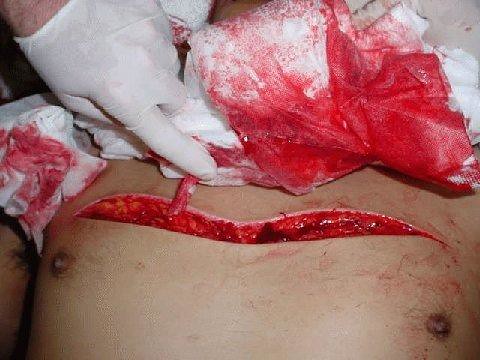
Bill Warner is the director of the Center for the Study of Political Islam (CSPI) and spokesman for politicalislam.com.
CSPI’s goal is to teach the doctrine of political Islam through its books and it has produced an eleven book series on political Islam.
Mr. Warner did not write the CSPI series, but he acts as the agent for a group of scholars who are the authors. The Center’s latest book is The Submission of Women and Slaves, Islamic Duality.
Here is part of an interview with FrontPage Magazine:
Slavery is the fruit of Islamic duality.
Mohammed, the master of dualism and submission, used slavery as a tool of jihad because it worked. Mohammed’s life was infused with slavery. Slaves were the lifeblood of Islam. Mohammed, the white man, owned both male and female black slaves. His attitude was pure dualism.
The most disgusting thing about Islamic slavery is not that Muslims enslave others, but that we ignore it. The Muslims have been fed the Koran and the Sunna in their mother's milk. They are doing what is ethical according to Islam. In a strange way, Muslims are to be pitied. A Muslim is the first victim of Islam.
The criticism of whites because of their being involved in slavery is standard fare in the media and the universities.
Try to find a university that even teaches about the killing of 120,000,000 Africans for Muslims to profit from the 24,000,000 resulting slaves.
Blacks define themselves on the basis of slavery. They will not go beyond the white, Christian version of slavery. There is only one theory of history in the black community—the West African Limited Edition version of history.
Blacks will not admit the broad scope of slave history.
Hindu slavery? It never happened.
White and European slavery? It never happened.
Slavery on the East coast of Africa? It never happened.
A massive slave trade through the Sahara into North Africa? It never happened.
Black, eunuchs at the Medina mosque? It never happened.
This incomplete history of slavery is what U.S. and European taxpayers fund in the state universities.
How can black leaders ignore Islam's sacred violence in Africa?
Why aren’t the black columnists, writers, professors, or ministers speaking out? They are ignorant and in total denial. They are the molested children of Islam. They fear angering the Black Moslem Brotherhood and losing the victim status they have establsihed.
Blacks are dhimmis and serve Islam with their silence. There is a deep fear of Islam that makes them overlook and placate Islam.
Arabs are the masters of blacks.
One thing whites and blacks have in common is that their ancestors were enslaved by Islam, and both are too ignorant to know it.
Blacks and whites have a secret shame buried under the denial of being slaves inside Islam.
But the rest of the media and intellectuals line up as dhimmis, too.
One of the marks of a dhimmi under the fourth caliph, Umar, was that a dhimmi was forbidden to study the Koran.
The chief mark of dhimmitude today is ignorance of the Koran, the Sira and the Hadith. The ignorance of kafir intellectuals about Islam is profound.
They don't know about how jihad killed the 120,000,000 Africans, the 60,000,000 Christians, the 80,000,000 Hindus or the 10,000,000 Buddhists.
Our intellectuals do not know about the Tears of Jihad (detailed in all of our books). That is a lot of death and ignorance—270,000,000 dead. Our intellectuals don't know, don't care and don't bother. They deny.
University Islamic studies never mention the Islamic political doctrine.
The media discusses Islam in terms of political correctness, and multiculturalism. History courses don’t teach about the civilizational annihilation due to jihad.
Religious leaders placate imams in public gatherings and have no knowledge what the imam actually thinks of them. Political thinkers do not even know Islam as a political force.
The problem with this ignorance is that our intellectuals are unable to help us. They do not understand that Islam is a civilization based upon the ideal of dualism.
Islamic ethics and politics have one set of rules for Muslims and another for kafirs.
Our civilization is based upon the ideal of unitary ethics, the Golden Rule. We do not have two sets of laws and ethics, like Islam. Our intellectuals cannot explain what dualism has meant in the past or what it will mean for our future—civilizational annihilation.
Our intellectuals and the media have only one view of Islam—a glorious civilization. (As spoon fed to them).
They have created the "terrorist", a bogus term based upon ignorance. And the "terrorist" is not even a "real" Muslim, but an extremist fundamentalist.
All of these terms are based upon a profound ignorance of Islamic political doctrine and are intended as a false balm to soothe us.
Intellectuals cannot connect the dots of persecution of other intellectuals and artists today, such as Salman Rushdie, Theo van Gogh, the Mohammed cartoon riots, and Daniel Pearl.
This persecution is part of a 1400 year Islamic tradition of keeping all intellectuals and artists in line with the doctrine of political Islam.
But for our intellectuals, there is no history, no connection, no pattern, no doctrine of Islam. Their only doctrine is the doctrine of denial. These intellectuals write our textbooks. Then our tax dollars buy the books to feed the ignorance.
What explains the intellectuals’ silence and ignorance?
The enormous violence of jihad has produced the psychology of the “molested child” syndrome. Intellectuals fear, apologize for, and placate the Islamic abusers, ignoring the violence of the past.
Then they turn around and advise our politicians. The result is an ignorant populace who look to our intellectuals for guidance and find treachery and lies.
They forget that:
Islam’s stand on slavery is based on its political principles of submission and duality.
The principle of submission could not be clearer. By definition a slave is the most submissive of all people. You become a slave only when you have no more choices. A slave has completely submitted to a master.
The principle of duality is shown by the fact that Islam does not enslave Muslims, only kafirs (non-Muslims). Since only kafirs are enslaved, it assures that more of the world submits to Islam.
Islamic slavery is based on the Trilogy of the Koran, the Sira (Mohammed’s life) and the Hadith (the Traditions of Mohammed). All three texts say that slavery is permitted, ethical, desirable and a virtue. There is not one single negative word about slavery.
Slavery is seen as a process that brings kafirs to Islam. It is a virtue to free slaves, but Mohammed only freed slaves who submitted to Islam. If the kafir slave does not submit, then their children will. So given enough time, slaves convert to Islam. That is one of the reasons that Islam sees slavery as a positive.
Of course, there is another reason that Islam sees slavery as being so "good" and that is the money.
Mohammed and the other jihadists made a fortune out of enslaving kafirs. Mohammed used the money for more jihad. So slavery financed the spread of Islam and jihad from the beginning.
All morality in Islam is patterned after the example of Mohammed, the perfect being. Everything that he did and said defines what is permitted or “good”.
Mohammed repeatedly sanctioned forced sex (rape) with kafir females after they were captured. The Hadith clearly reports that he got first choice of the women.
In one case, he repeatedly demanded one particular woman for himself and swapped two other kafir slave women for his choice. So if Mohammed was involved in the rape of kafirs, then rape is a virtue, not a sin or error.
When Mohammed destroyed the B. Qurayza tribe, all of the adult male Jews were beheaded, so that no husbands were left. Mohammed then took the children and gave them to Muslims to raise as Muslims and he sold off the Jewish women as slaves.
We know from another story that the women were divided into sex slaves and domestic slaves. In one scene, a jihadist is trying to obtain a high ransom for a woman and he is told that her breasts are flat and her mouth is cold, so her value was less. In short, she was only good for work around the house, not in the bedroom.
The Hadith tells of another story where the Muslims used coitus interruptus to avoid impregnating the kafir sex slaves. The reason was purely for business. If the kafir sex slave was pregnant, then she was worth less money.
Islamic doctrine says that kafir women should not be used for prostitutes, only for the pleasure of the master.
When Mohammed attacked the Jews at Khaybar, many moral precedents were set. Sexual slavery received an entire set of rules. Muslims were not to rape pregnant or menstruating women until they had delivered the child or finished their periods. At Khaybar, Mohammed’s god Allah, announced that even married women were fair game for rape.
Mohammed only killed some of the Jews at Khaybar. The male and female survivors were needed to work the land as dhimmis.
(The original dhimmis were semi-slaves with no civil rights. Today, dhimmis are ignorant kafirs who apologize for Islam.)
Since Islam needed the men to work, husbands were left alive. That was the reason that the Koran said that in this case, even with the husbands looking on, it was good to rape the women.
Sexual slavery was not only fun and profitable for the Muslim men, but rape was a powerful tactic of war, then and today. The women are forced into submission to Muslim men and the husbands are humiliated.
Humiliated men are weakened men, so more kafirs were less able to resist Islam.
For some time Mohammed's favorite sex partner was a Christian slave from Egypt named Mary. One of Mohammed's wives caught him in some state of intimacy with Mary in the wife's bedroom and raised hell.
Mohammed promised to not do it again and moved Mary to her own apartment in Medina.
Everything that has been said up to now is not only history; it is Sunna (the example of the perfect pattern of action and morality found in Mohammed).
Rape is Sunna. Rape is not a sin. Rape is permitted and encouraged by Mohammed and the Koran. Islam is the only political system in the world that includes rules for rape and war. Rape is jihad. How good can it get? A Muslim gets to rape a kafir girl and get heaven credits. All jihad is a ticket to Paradise.
The most disgusting aspect of the Islamic rape of kafirs is not the rapes, but the kafir response. Kafirs become dhimmis by ignoring the rapes. I challenge you to find one, even one, mention of Islamic rape in the history books.
Islamic rape is more taboo than the N-word in the Mass Mainstream Media. At least the N-word is acknowledged to exist. Even unicorns exist in media fantasy. But Islamic rape is forbidden to even exist as a fantasy.
And to reach a fevered rant: our so-called "feminist" scholars are absolutely intellectually and morally bankrupt hypocrites.
They are traitors to our culture and a shame and a disgrace. They remain silent in the face of heinous crimes against women. They are arch-dhimmis when they refuse to speak of the Sunna, history and current rapes of our daughters, mothers, and sisters.
And our tax dollars support their evil in our public universities.
Thursday, November 22, 2007
ISLAM CREATING HUGE PROBLEMS IN EUROPE
DENMARK'S "TROUBLES" EMERGING IN NEIGHBORHOODS NEAR YOU IN THE USA - JUST A MATTER OF TIME. Hispanic and other illegal immigration has already provided a foretaste with more limited violence - except for gangs like MS 13 - attached to it.
*This is rather long but well said and interesting. It is only the tip of the iceberg in Europe and likely elsewhere too. The Netherlands and Britain have had their problems along with the French.
Three years ago when my friend Dollie and I were laying over in Oslo, waiting to take the train across Norway to Bergen to board the Coastal Ferry for a trip up the coast and around the North Cape, we took a sightseeing walk and stopped in a sidewalk cafe for a drink. I immediately noted the large number of Muslims,
particularly the women in their Burkhas, and so I said something to the waitress about it.
She immediatelly responded without hesitation, Yes, there
are too many of them. It is now obvious that their govt's socialized
benefits have attracted a growing number of Muslims and they are finding it difficult to cope.
That has been particularly true in the Netherlands, France, and Britain as well as Denmark. Live and Learn. RC
We all know about what's happening in Denmark and Europe as well but what is written here reinforces the knowledge of the horrible march of the Muslim plague The situation in Denmark is no different than the rest of Europe.
We're too politically correct to put together our problem. Is this fear mongering or a recitation of facts?
Here is a preview of what is in store for America & the free world, if we don't pay attention to what is happening to our World!!!
Salute the Danish Flag - it's a Symbol of Western Freedom By Susan MacAllen
In 1978-9 I was living and studying in Denmark . But in 1978 - even in Copenhagen , one didn't see Muslim immigrants. The Danish population embraced visitors, celebrated the exotic, went out of its way to protect each of its citizens.
It was proud of its new brand of socialist liberalism - one in development since the conservatives had lost power in 1929 - a system where no worker had to struggle to survive, where one ultimately could count upon the state as in, perhaps, no other western nation at the time.
The rest of Europe saw the Scandinavians as free
thinking, progressive and infinitely generous in their welfare policies. Denmark boasted low crime rates, devotion to the environment, a superior educational system and a history of humanitarianism.
Denmark was also most generous in its immigration policies - it offered the best welcome in Europe to the new immigrant: generous welfare payments from first arrival plus additional perks in transportation, housing and education. It was determined
to set a world example for inclusiveness and multiculturalism.
How could it have predicted that one day in 2005 a series of political cartoons in a newspaper would spark violence that would leave dozens dead in the streets - all because its commitment to multiculturalism would come back to bite?
By the 1990's the growing urban Muslim population was obvious - and its unwillingness to integrate into Danish society was obvious. Years of immigrants had settled into Muslim-exclusive enclaves.
As the Muslim leadership became more vocal about what they considered the decadence of Denmark 's liberal way of life, the Danes - once so welcoming - began to feel slighted. Many Danes had begun to see Islam as incompatible with their long-standing values: belief in personal liberty and free speech, in equality for women, in tolerance for other ethnic groups, and a deep pride
in Danish heritage and history.
The New York Post in 2002 ran an article by Daniel Pipes and Lars Hedegaard, in which they forecasted accurately that
the growing immigrant problem in Denmark would explode. In the article they reported: "Muslim immigrants constitute 5 percent of the population but consume upwards of 40 percent of the welfare spending."
"Muslims are only 4 percent of Denmark 's 5.4 million people but make up a majority of the country's convicted rapists, an especially combustible issue given that practically all the female victims are non-Muslim. Similar, if lesser, disproportions are found in other crimes."
"Over time, as Muslim immigrants increase in numbers, they wish less to mix with the indigenous population. A recent survey finds that only 5 percent of young Muslim immigrants would readily marry a Dane." "Forced marriages - promising a newborn daughter in Denmark to a male cousin in the home country, then compelling her to marry him, sometimes on pain of death - are one problem."
"Muslim leaders openly declare their goal of introducing Islamic law once Denmark 's Muslim population grows large enough - a not-that-remote prospect. If present trends persist, one sociologist estimates, every third inhabitant of Denmark
in 40 years will be Muslim."
It is easy to understand why a growing number of Danes would feel that Muslim immigrants show little respect for Danish
values and laws.
An example is the phenomenon common to other European countries and the U.S. : some Muslims in Denmark who opted to leave the Muslim faith have been murdered in the name of Islam, while others hide in fear for their lives. Jews are also threatened and harassed openly by Muslim leaders in Denmark , a country where once Christian citizens worked to smuggle out nearly all of their 7,000 Jews by night to Sweden - before the Nazis could invade.
I think of my Danish friend Elsa - who as a teenager had dreaded crossing the street to the bakery every morning under the eyes of
occupying Nazi soldiers - and I wonder what she would say today.
In 2001, Denmark elected the most conservative government in some 70 years - one that had some decidedly non-generous ideas about liberal unfettered immigration.
Today Denmark has the strictest immigration policies in Europe . ( Its effort to protect itself has been met with accusations of "racism" by liberal media across Europe - even as other governments struggle to right the social problems wrought by years of too-lax immigration.) If you wish to become Danish, you must attend three years of language classes. You must pass a test on Denmark 's history, culture, and a Danish language test.
You must live in Denmark for 7 years before applying for citizenship. You must demonstrate an intent to work, and have a job waiting. If you wish to bring a spouse into Denmark , you must both be over 24 years of age, and you won't find it so easy anymore to move your friends and family to Denmark with you.
You will not be allowed to build a mosque in Copenhagen.
Although your children have a choice of some 30 Arabic culture and language schools in Denmark , they will be strongly encouraged to assimilate to Danish society in ways that past immigrants weren't.
In 2006, the Danish minister for employment, Claus Hjort Frederiksen, spoke publicly of the burden of Muslim immigrants on the Danish welfare system, and it was horrifying: the
government's welfare committee had calculated that if immigration from Third World countries were blocked, 75 percent of the cuts needed to sustain the huge welfare system in coming decades would be unnecessary.
In other words, the welfare system as it existed was being exploited by immigrants to the point of eventually bankrupting the government. "We are simply forced to adopt a new policy on immigration. The calculations of the welfare committee
are terrifying and show how unsuccessful the integration of immigrants has been up to now," he said.
A large thorn in the side of Denmark 's imams is the Minister of Immigration and Integration, Rikke Hvilshoj. She makes no
bones about the new policy toward immigration, "The number of foreigners coming to the country makes a difference," she says, "There is an inverse correlation between how many come here and how well we can receive the foreigners that come. "
And on Muslim immigrants needing to demonstrate a willingness to blend in, "In my view, Denmark should be a country with room for different cultures and religions. Some values, however, are more important than others. We refuse to question democracy, equal rights, and freedom of speech." Hvilshoj has paid a price for her show of backbone.
Perhaps to test her resolve, the leading radical imam in Denmark , Ahmed Abdel Rahman Abu Laban, demanded that the government pay blood money to the family of a Muslim who was murdered in a suburb of Copenhagen , stating that the family's thirst for revenge could be thwarted for money.
When Hvilshoj dismissed his demand, he argued that in Muslim culture the payment of retribution money was common, to which Hvilshoj replied that what is done in a Muslim country is not necessarily what is done in Denmark .
The Muslim reply came soon after: her house was torched while she, her husband and children slept. All managed to escape unharmed, but she and her family were moved to a secret location and she and other ministers were assigned bodyguards for the first time - in a country where such murderous violence
was once so scarce.
Her government has slid to the right, and her borders have tightened. Many believe that what happens in the next decade will
determine whether Denmark survives as a bastion of good living, humane thinking and social responsibility, or whether it becomes a nation at civil war with supporters of Sharia law.
And meanwhile, Americans clamor for stricter immigration policies, and demand an end to state welfare programs that allow many immigrants to live on the public dole.
As we in America look at the enclaves of Muslims amongst us, and see those who enter our shores too easily, dare live on our taxes, yet refuse to embrace our culture, respect our traditions, participate in our legal system, obey our laws, speak our language, appreciate our history.
We would do well to look to Denmark , and say a prayer for her future and for our own.---Amen
*This is rather long but well said and interesting. It is only the tip of the iceberg in Europe and likely elsewhere too. The Netherlands and Britain have had their problems along with the French.
Three years ago when my friend Dollie and I were laying over in Oslo, waiting to take the train across Norway to Bergen to board the Coastal Ferry for a trip up the coast and around the North Cape, we took a sightseeing walk and stopped in a sidewalk cafe for a drink. I immediately noted the large number of Muslims,
particularly the women in their Burkhas, and so I said something to the waitress about it.
She immediatelly responded without hesitation, Yes, there
are too many of them. It is now obvious that their govt's socialized
benefits have attracted a growing number of Muslims and they are finding it difficult to cope.
That has been particularly true in the Netherlands, France, and Britain as well as Denmark. Live and Learn. RC
We all know about what's happening in Denmark and Europe as well but what is written here reinforces the knowledge of the horrible march of the Muslim plague The situation in Denmark is no different than the rest of Europe.
We're too politically correct to put together our problem. Is this fear mongering or a recitation of facts?
Here is a preview of what is in store for America & the free world, if we don't pay attention to what is happening to our World!!!
Salute the Danish Flag - it's a Symbol of Western Freedom By Susan MacAllen
In 1978-9 I was living and studying in Denmark . But in 1978 - even in Copenhagen , one didn't see Muslim immigrants. The Danish population embraced visitors, celebrated the exotic, went out of its way to protect each of its citizens.
It was proud of its new brand of socialist liberalism - one in development since the conservatives had lost power in 1929 - a system where no worker had to struggle to survive, where one ultimately could count upon the state as in, perhaps, no other western nation at the time.
The rest of Europe saw the Scandinavians as free
thinking, progressive and infinitely generous in their welfare policies. Denmark boasted low crime rates, devotion to the environment, a superior educational system and a history of humanitarianism.
Denmark was also most generous in its immigration policies - it offered the best welcome in Europe to the new immigrant: generous welfare payments from first arrival plus additional perks in transportation, housing and education. It was determined
to set a world example for inclusiveness and multiculturalism.
How could it have predicted that one day in 2005 a series of political cartoons in a newspaper would spark violence that would leave dozens dead in the streets - all because its commitment to multiculturalism would come back to bite?
By the 1990's the growing urban Muslim population was obvious - and its unwillingness to integrate into Danish society was obvious. Years of immigrants had settled into Muslim-exclusive enclaves.
As the Muslim leadership became more vocal about what they considered the decadence of Denmark 's liberal way of life, the Danes - once so welcoming - began to feel slighted. Many Danes had begun to see Islam as incompatible with their long-standing values: belief in personal liberty and free speech, in equality for women, in tolerance for other ethnic groups, and a deep pride
in Danish heritage and history.
The New York Post in 2002 ran an article by Daniel Pipes and Lars Hedegaard, in which they forecasted accurately that
the growing immigrant problem in Denmark would explode. In the article they reported: "Muslim immigrants constitute 5 percent of the population but consume upwards of 40 percent of the welfare spending."
"Muslims are only 4 percent of Denmark 's 5.4 million people but make up a majority of the country's convicted rapists, an especially combustible issue given that practically all the female victims are non-Muslim. Similar, if lesser, disproportions are found in other crimes."
"Over time, as Muslim immigrants increase in numbers, they wish less to mix with the indigenous population. A recent survey finds that only 5 percent of young Muslim immigrants would readily marry a Dane." "Forced marriages - promising a newborn daughter in Denmark to a male cousin in the home country, then compelling her to marry him, sometimes on pain of death - are one problem."
"Muslim leaders openly declare their goal of introducing Islamic law once Denmark 's Muslim population grows large enough - a not-that-remote prospect. If present trends persist, one sociologist estimates, every third inhabitant of Denmark
in 40 years will be Muslim."
It is easy to understand why a growing number of Danes would feel that Muslim immigrants show little respect for Danish
values and laws.
An example is the phenomenon common to other European countries and the U.S. : some Muslims in Denmark who opted to leave the Muslim faith have been murdered in the name of Islam, while others hide in fear for their lives. Jews are also threatened and harassed openly by Muslim leaders in Denmark , a country where once Christian citizens worked to smuggle out nearly all of their 7,000 Jews by night to Sweden - before the Nazis could invade.
I think of my Danish friend Elsa - who as a teenager had dreaded crossing the street to the bakery every morning under the eyes of
occupying Nazi soldiers - and I wonder what she would say today.
In 2001, Denmark elected the most conservative government in some 70 years - one that had some decidedly non-generous ideas about liberal unfettered immigration.
Today Denmark has the strictest immigration policies in Europe . ( Its effort to protect itself has been met with accusations of "racism" by liberal media across Europe - even as other governments struggle to right the social problems wrought by years of too-lax immigration.) If you wish to become Danish, you must attend three years of language classes. You must pass a test on Denmark 's history, culture, and a Danish language test.
You must live in Denmark for 7 years before applying for citizenship. You must demonstrate an intent to work, and have a job waiting. If you wish to bring a spouse into Denmark , you must both be over 24 years of age, and you won't find it so easy anymore to move your friends and family to Denmark with you.
You will not be allowed to build a mosque in Copenhagen.
Although your children have a choice of some 30 Arabic culture and language schools in Denmark , they will be strongly encouraged to assimilate to Danish society in ways that past immigrants weren't.
In 2006, the Danish minister for employment, Claus Hjort Frederiksen, spoke publicly of the burden of Muslim immigrants on the Danish welfare system, and it was horrifying: the
government's welfare committee had calculated that if immigration from Third World countries were blocked, 75 percent of the cuts needed to sustain the huge welfare system in coming decades would be unnecessary.
In other words, the welfare system as it existed was being exploited by immigrants to the point of eventually bankrupting the government. "We are simply forced to adopt a new policy on immigration. The calculations of the welfare committee
are terrifying and show how unsuccessful the integration of immigrants has been up to now," he said.
A large thorn in the side of Denmark 's imams is the Minister of Immigration and Integration, Rikke Hvilshoj. She makes no
bones about the new policy toward immigration, "The number of foreigners coming to the country makes a difference," she says, "There is an inverse correlation between how many come here and how well we can receive the foreigners that come. "
And on Muslim immigrants needing to demonstrate a willingness to blend in, "In my view, Denmark should be a country with room for different cultures and religions. Some values, however, are more important than others. We refuse to question democracy, equal rights, and freedom of speech." Hvilshoj has paid a price for her show of backbone.
Perhaps to test her resolve, the leading radical imam in Denmark , Ahmed Abdel Rahman Abu Laban, demanded that the government pay blood money to the family of a Muslim who was murdered in a suburb of Copenhagen , stating that the family's thirst for revenge could be thwarted for money.
When Hvilshoj dismissed his demand, he argued that in Muslim culture the payment of retribution money was common, to which Hvilshoj replied that what is done in a Muslim country is not necessarily what is done in Denmark .
The Muslim reply came soon after: her house was torched while she, her husband and children slept. All managed to escape unharmed, but she and her family were moved to a secret location and she and other ministers were assigned bodyguards for the first time - in a country where such murderous violence
was once so scarce.
Her government has slid to the right, and her borders have tightened. Many believe that what happens in the next decade will
determine whether Denmark survives as a bastion of good living, humane thinking and social responsibility, or whether it becomes a nation at civil war with supporters of Sharia law.
And meanwhile, Americans clamor for stricter immigration policies, and demand an end to state welfare programs that allow many immigrants to live on the public dole.
As we in America look at the enclaves of Muslims amongst us, and see those who enter our shores too easily, dare live on our taxes, yet refuse to embrace our culture, respect our traditions, participate in our legal system, obey our laws, speak our language, appreciate our history.
We would do well to look to Denmark , and say a prayer for her future and for our own.---Amen
VIEW INSIDE THE IRAQ SURGE - Excellent
Inside the Surge
The American military finds new allies, but at what cost?
by Jon Lee Anderson
November 19, 2007
A man suspected of Mahdi Army activity is detained during a recent raid in Baghdad. General David Petraeus has singled out Ghazaliya,a mostly Sunni district in the western part of the city, as an area where the military has made progress. Photograph by Johan Spanner.
Joint Security Station Thrasher, in the western Baghdad suburb of Ghazaliya, is housed in a Saddam-era mansion with twenty-foot columns and a fountain, now dry, that looks like a layer cake of concrete and limestone. The mansion and two adjacent houses have been surrounded by blast walls.
J.S.S. Thrasher was set up last March, and is part of the surge in troops engineered by General David Petraeus, the American commander in Iraq. Moving units out of large bases and into Joint Security Stations—small outposts in Baghdad’s most dangerous districts—has been crucial to Petraeus’s counterinsurgency strategy, and Thrasher is now home to a hundred American soldiers and a few hundred Iraqis.
This fall, on the roof of the mansion, amid sandbags, communications gear, and exercise equipment protected by a sniper awning, Captain Jon Brooks, Thrasher’s commander, pointed out some of the local landmarks. “This site was selected because it was the main body drop in Ghazaliya,” he said, indicating a grassy area nearby. “There were up to eleven bodies a week. Most were brutally mutilated.”
CLICK ON TITLE/HEADING FOR FULL STORY IN THE NEW YORKER - great insight into what's going on. Worth the read.
The American military finds new allies, but at what cost?
by Jon Lee Anderson
November 19, 2007
A man suspected of Mahdi Army activity is detained during a recent raid in Baghdad. General David Petraeus has singled out Ghazaliya,a mostly Sunni district in the western part of the city, as an area where the military has made progress. Photograph by Johan Spanner.
Joint Security Station Thrasher, in the western Baghdad suburb of Ghazaliya, is housed in a Saddam-era mansion with twenty-foot columns and a fountain, now dry, that looks like a layer cake of concrete and limestone. The mansion and two adjacent houses have been surrounded by blast walls.
J.S.S. Thrasher was set up last March, and is part of the surge in troops engineered by General David Petraeus, the American commander in Iraq. Moving units out of large bases and into Joint Security Stations—small outposts in Baghdad’s most dangerous districts—has been crucial to Petraeus’s counterinsurgency strategy, and Thrasher is now home to a hundred American soldiers and a few hundred Iraqis.
This fall, on the roof of the mansion, amid sandbags, communications gear, and exercise equipment protected by a sniper awning, Captain Jon Brooks, Thrasher’s commander, pointed out some of the local landmarks. “This site was selected because it was the main body drop in Ghazaliya,” he said, indicating a grassy area nearby. “There were up to eleven bodies a week. Most were brutally mutilated.”
CLICK ON TITLE/HEADING FOR FULL STORY IN THE NEW YORKER - great insight into what's going on. Worth the read.
Monday, November 19, 2007
IRAN AGENTS FOR BRITISH HOSAGES

The kidnapping of five British contractors - four security guards and a financial consultant - has long been suspected of being an Iranian-backed job. A recent report in the Times Online confirmed an Iranian extremist group has demanded the release of Qais Qazali, the leader of the Iranian-backed Qazali network, in exchange for the five Britons.
"Senior Iraqi government sources say their captors have promised they will not be harmed but any rescue attempt would endanger them," the Times Online reported. "They claimed the hostages will remain prisoners 'for as long as it takes' to secure the release of Qais Qazali, a former chief spokesman for the Shi’ite Mahdi Army."
The British have been unable to secure the release of their citizens as the US military has refused to release Qazali. "Talks aimed at freeing the hostages are believed to have reached deadlock this month after British negotiators said they had no power to free Qazali," said the Times Online.
Qazali is not a low level Shia extremist commander, but one of the most senior Iranian-backed terrorists captured in Iraq. Qazali, along with US Ali Mussa Daqduq, Mahmud Farhadi, and Azhar al Dulaimi are the four most senior Iranian Qods Force agents captured or killed in Iraq since Coalition forces began targeting the Iranian networks. US Special Forces captured senior members of Iran's Qods Force in Baghdad in December 2006 and Irbil in January 2007.
Iranian surrogates -- the Qazali and Sheibani networks, which are now collectively referred to as the Special Groups -- stepped up their attacks on Iraqi and Coalition forces in January 2007.
Daqduq is a senior Hezbollah operative who was tasked by Iran to organize the Special Groups and "rogue" Mahdi Army cells along the lines of Lebanese Hezbollah. He is a 24-year veteran of Hezbollah, and commanded both a Hezbollah special operations unit and Hezbollah leader Hassan Nasrallah’s security detail.
Farhadi was the commander of the Zafr Command, one of three units subordinate to the Ramazan Corps of the Qods Force. The Ramazan Corps is responsible for Qods Force operations in Iraq. As the Zafr Commander, Farhadi was responsible for all Qods Force operations in north-central Iraq, including cross-border transfers of weapons, fighters and money.
Azhar al Dulaimi is the mastermind and tactical commander of the complex attack on the Provincial Joint Coordination Center in Karbala on January 20th as well as other high profile terror attacks in Iraq. Five US soldiers were killed during the Karbala attack and subsequent kidnapping attempt. Dulaimi was killed in a raid in Baghdad last summer.
In March 2007, Coalition forces captured Qais Qazali, his brother Laith Qazali, and several other members of the Qazali network. Qazali was a spokesperson and senior aide to Muqtada al Sadr and has been since identified as a senior member of the Special Groups.
The Qazali network conducted sophisticated operations against US forces at the Karbala Joint Provincial Coordination Center, kidnapping and killing five US soldiers during the aborted operation. Coalition and Iraqi Security Forces have been heavily targeting these "Special Groups" and "Secret Cells" since General David Petraeus' briefing on the Qazali and Sheibani networks on April 26.
Recently, the US military and the Iraqi government have praised Iran for slowing the flow of weapons into Iraq. Attacks with the deadly Iranian made explosively formed projectile mines, or EFPs, have decreased dramatically and new caches are not being found. The US recently released nine Iranians held in Iraq, including two Qods Force officers detained in Irbil earlier this year.
Subscribe to:
Posts (Atom)


